

The Australian Government claims that Pacific labour mobility creates a beneficial partnership for all stakeholders, namely workers, participating countries, and Australian employers. However, the reality is much more complex, and the evidence of exploitation, fear of reporting, and restriction of labour mobility suggests a different question: what is the line between an opportunity and dependency?
In 2024, the ABC News told the story of Ezekiel, a Papua New Guinean worker who arrived to Australia via Pacific labour mobility scheme to work as a picker of fruit. He worked long hours, sometimes seven days per week, and his employer was deducting accommodation and travel costs from his salary. Thus, what was left for him — approximately $200-$300 per week — was intended to cover his food expenses, and only after that he could send some money home to his mother who was raising his two children since his wife had passed away because of cancer.
Later on, the labour-hire company which had been sponsoring him filed for liquidation. In particular, ABC news informed that at that time the Fair Work Ombudsman was looking into complaints that the company was underpaying and exploiting workers.
It would be inappropriate to use this story as an example that is common for all participants of PALM scheme such interpretation turns one case into generalisation regarding tens of thousands of people who experience completely different treatment. However, it would be inappropriate to dismiss this story in the context of current findings from official inquiries and independent studies regarding this topic.
Therefore, the right question is not whether PALM is either success or scandal. Instead, the issue here is whether it is appropriate to allocate risks equally among the parties while generating certain economic and development benefits.
A program with two policy purposes
Through PALM programme, eligible Australian employers can recruit workers from nine Pacific island countries and Timor-Leste in the roles where there are no local employees available. The short-term stream involves placements up to nine months a year; long-term placement lasts from one to four years. (Parliamentary Library quick guide)
Currently used PALM scheme was established on 4 April 2022 when Seasonal Worker Programme and Pacific Labour Scheme were united under PALM umbrella, and then consolidated under the same deed and guidelines in July 2023. However, the roots of this scheme are deeper — Pacific seasonal-worker pilot was introduced by Australia in 2008, and Permanent Seasonal Worker Programme was launched in 2012.
Thus, PALM has developed into a major component of the labour market of Australia. Currently, there are 32,645 workers who participate in the scheme, 16,050 short-term workers and 16,595 long-term workers are employed by 556 approved employers, 443 direct employers and 113 labour-hire companies.
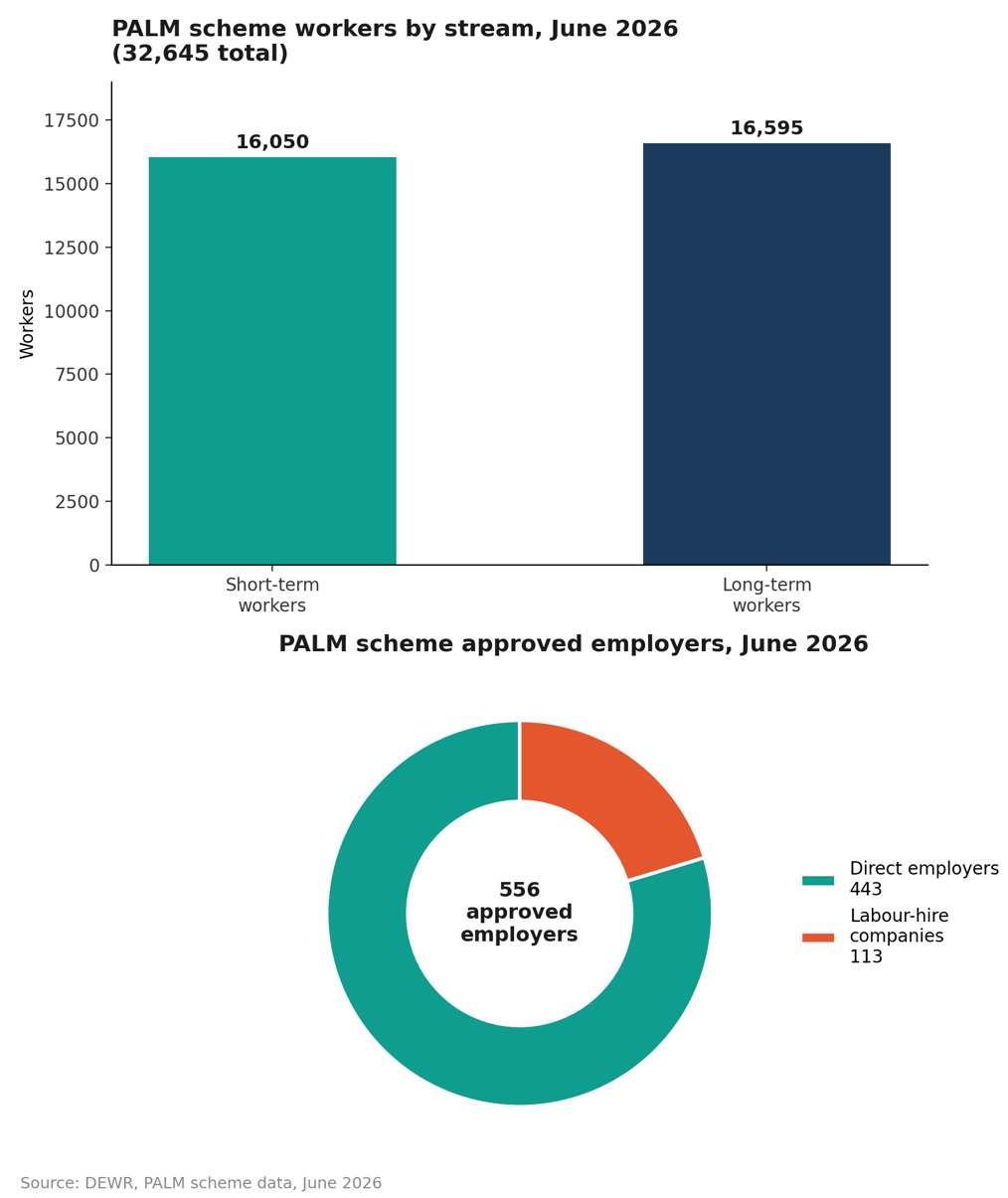
At the same time, this scheme pursues two policy purposes. For Australia, it is a means to overcome shortage of labour in sectors where employers find it difficult to recruit local workers. For participating Pacific countries and Timor-Leste, this scheme is supposed to generate income, skills and other development benefits from temporary labour migration.
Such programme is presented by the government as a "triple win" for workers, participating countries and Australian employers. However, there are evidences for this claim, but risks are not necessarily shared in the same way.
Development dividend is real
It would be irresponsible for anyone to criticise PALM and not acknowledge from the outset the reality of what it does right.
Department of Foreign Affairs and Trade (DFAT) calculates that workers employed in PALM returned $450 million of earnings to their countries in the fiscal year 2024-25, in which the programme employed on average 30,000 workers. This is a real transfer of money into the hands and communities of those countries, including Timor-Leste.
There is an independent proof for that. World Bank and ANU Pacific Labour Mobility Survey surveyed 2,085 workers and 4,241 households in the context of Australian and New Zealand labour mobility programmes and found that the participants are paid approximately three to four times higher compared to what they would earn at home in case of Tongan, and up to ten times as much in case of ni-Vanuatu. In addition, almost 60% of their income could still be saved or sent back home after taxes and deductions – and the survey demonstrated high level of satisfaction of workers.
None of the above suggests that exploitation reports are fabricated or not representative. It simply means that development narrative of PALM is not a figment of imagination as well. For many workers, this programme creates economic opportunities that would be impossible to achieve back home, bringing real benefits to their family and community, while Australian businesses indeed get access to the workers they claim cannot be sourced locally.
Therefore, the stronger argument against PALM is that the way this programme works may make workers vulnerable in case of any problems.
Harms are also documented
In September 2024, Anti-slavery Commissioner for NSW Dr James Cockayne released his report called Be Our Guests, which examines the risks of modern slavery among temporary migrant workers in rural and regional NSW, based on his office's two years of assistance work, direct contacts with workers and regional consultations. Commissioner's office had direct contact with more than 80 PALM workers – out of which more than 30 had disengaged from the programme – and identified more than 200 persons who left the programme because of abuse and exploitation.
The report highlighted patterns which can be regarded as forced labour and deceptive recruitment, and in some cases even signs of sexual servitude and developing labour trafficking.
It is worth mentioning what the Commissioner did not state in his report. He did not draw the conclusion that modern slavery is typical for the PALM workers – in fact, he explicitly said that migration programmes are, for the most part, well managed, and the most serious risks affect only minority of the workers. Moreover, this was not a criminal investigation, as the office of the Commissioner does not have normal law-enforcement powers.
What was proved by the report, is that some temporary migrant workers face vulnerabilities in areas of employment, accommodation, healthcare, isolation and migration status.
These vulnerabilities did not stay unnoticed. On 6 August 2026, NSW Parliament Modern Slavery Committee tabled its final report regarding the same issue, compiled after hearings, submissions and evidences of workers, government agencies, employers, unions and community groups. Committee made 31 recommendations, including simplified pathways for PALM workers to change employer, an urgent establishment of the labour-hire licensing scheme in NSW, and expansion of Medicare eligibility of temporary migrant workers. The government's official response is expected until 6 November 2026.
Overall, the evidence shows neither a universally exploitation-ridden system, nor a system without any problems. But what it does show, is a concentration of vulnerability.
The fundamental problem is bargaining power
The scheme's rights and complaint channels, alongside government services and processes for transfer and re-engagement in a different approved employer position, give PALM workers the same workplace rights as any other worker in Australia. But nothing can give them the freedom of mobility that the typical Australian worker enjoys.
They don't get such freedom because they cannot freely move in and out of their employment in PALM, just like any other worker. Their visa and their legal employment status depend on each other, and once a PALM worker leaves an approved employer, he/she is considered to be disengaged from the scheme, not just left a job. Re-engagement is sometimes possible, but it is managed by processes between the government and the employers and cannot be chosen directly by the worker.
That structure affects the bargaining power within the employment relationship and it shows in the research by the Migrant Justice Institute. In its 2024 National Survey on Access to Justice for Workers on the PALM Scheme, the organization received 370 valid answers. To be honest, it's hardly representative, because the respondents were primarily older, well-connected, long-serving, highly unionized workers; participation was also self-selected — but still, it says a lot.
As the research shows, 64% of workers want to change their employer if the scheme would allow them to do that. They mainly want it in order to receive better treatment or safer working conditions. And still, 97% of them wish to return to Australia and work under the PALM scheme again.
It's likely to explain a lot regarding why the workers don't complain. 64% of respondents fear the loss of their job due to making complaints, and 25% are afraid that making complaints will influence their ability — or the ability of other members of their family or the community — to return to Australia and continue their employment there.
It doesn't mean, of course, that all the approved employers exploit this structural advantage. It only means that if they do exploit it, the workers' possibilities to change employment are severely restricted compared to those of people who could simply go to another employer. Mobility in that case is not just a choice of workplace but rather a form of protection against an exploitative employer.
Canberra has increased worker protections
In order to make an objective evaluation of the PALM scheme in 2026, it should be mentioned that its rules have considerably changed over recent years.
According to the PALM Scheme Approved Employer Guidelines effective from 27 March 2026 (Version 2.1), an approved employer is obliged to provide short-term workers with at least 120 hours of work in every 4-week period and long-term workers with full-time hours (usually 38 hours a week) according to the particular workplace instrument. If an employer fails to do that, it faces other obligations, including the $200 minimum net-pay safeguard per week that applies in certain circumstances (unusually high deductions, reduced hours during the reconciliation period, or approved exceptional circumstances).
An employer should also adhere to the regulations concerning the deductions, accommodation, welfare, and pay parity that ensures workers from receiving the same full pay for comparable work performed at the same workplace as anybody else. A new family-accompaniment pilot enables up to 200 long-term workers to bring their families to Australia along with the access to Medicare, work/study rights for partners, and schooling for children.
But still, it doesn't actually solve the problem when the employment relationship is problematic itself.
Three reforms would help spread the risk more equitably
1. Strengthen the protected transfer component of supported mobility
PALM is not required to be an unrestricted work visa: it involves bilateral relationships and workforce planning, which sets it apart from the regular labour market in a way that we should not lose.
But there is a powerful argument for making it easier to switch between approved employers in case of serious difficulties. The NSW Modern Slavery Committee has now recommended amending the relevant visa settings for this purpose, and the Migrant Justice Institute has separately proposed the concept of "supported mobility." Such a reform could maintain the existing regulated structure of PALM but would greatly increase the presumption of the right to change the employer in the case of credible proof of mistreatment, hazardous working conditions, non-compliance with obligations or just a failed relationship altogether.
Such a protection mechanism is not helpful only when invoked. Knowledge of the possibility of switching employers may have a positive impact on the balance of power between the worker and employer even in case of no actual problems.
2. Extend access to Medicare
Another domain in which the issue of vulnerability associated with temporary status is important is the question of health care provision. The 2026 NSW inquiry noted that migrant workers face high initial medical expenses and inadequate insurance, and its recommendation on this matter calls for the NSW Government to pressure the Commonwealth to extend the eligibility of PALM participants in Medicare in priority order.
The family-accompaniment pilot already proves that such a measure is feasible on a small scale – access to Medicare is provided for the PALM workers and their families in the pilot project. But such a step does not prove that universal eligibility is the only solution to this problem – issues of cost, division of responsibilities between the Commonwealth and the state, and interaction with the private health sector have yet to be clarified. However, the pilot program is a good starting point for considering a more extensive access to Medicare for PALM workers. At least, workers' ability to receive basic medical services should not depend heavily on their employer.
3. Close NSW's labour-hire regulatory gap
This reform seems the most obvious of the three. The NSW parliamentary committee calls upon the state government to quickly introduce a labour-hire licensing scheme based on the Victorian model and designed to work with the future federal licensing scheme.
While PALM is operated by the Commonwealth, in practice, the workers pass through various schemes involving approved employers, host businesses, labour-hire providers and state regulators. This means that when something goes wrong, it is harder to clarify the responsibility party. Labour hire licensing will not prevent the exploitation itself, but will create additional obstacles for participation in this business, improve the monitoring and give the regulatory agencies the tool to deal with undesirable operators.
Development and dependency are not alternatives to each other
The title of this article implies choosing between development and dependency. The honest answer to this dilemma is that PALM generates both simultaneously.
The development aspects are quite substantial: more than 32,000 Pacific and Timorese workers participating in the program, hundreds of millions of dollars transferred to their home countries annually and independent studies proving significant income increase. On the other hand, this program creates an employment dependency of the participants since they cannot use the labour market in the same way as ordinary workers do. For the most part, when the relationship is going well, the restriction is barely noticeable. However, in case of problems, the consequences may be quite serious.
Therefore, the key aim must not be choosing between maintaining the program and protecting workers – the goal should be reducing the inequality in terms of the risk of employment without losing its development benefits. Making mobility between approved employers easier, improving access to health care and introducing labour-hire licensing would bring the program closer to a "triple win" it was originally intended to achieve.
At the same time, there is another policy consideration in the case. Australia describes the labour mobility program as an essential part of its relations with the Pacific countries and Timor-Leste, which is not only about the movement of labour but also about the connection between people, economies and societies of these countries. For tens of thousands of Pacific and Timorese citizens, PALM is one of the most direct contacts with Australia. It is not some theoretical construction dreamed up in Canberra – it is their salary, workplace, accommodation, access to a doctor, and what will happen when they will ask for help. If Australia wants to maintain the good reputation of the Pacific partner, then their experience of living under PALM is what will be decisive.
Key judgment
PALM is providing significant economic and developmental benefits, however, the employer-dependent nature of the program places an excess of risk on workers in case of failure of the employment relationship. The reform should be focused on the improvement of the supported mobility between the approved employers, access to healthcare and tightening of labour-hire regulation, while maintaining the rest of the development benefits of the program.
Information and policy settings are current to 24 August 2026. Participation in the PALM varies on a month-to-month basis; June 2026 is the last month for which data is available at the time of publication.